
Rachel R. Harman, Ph.D.
Overall Research Interests
I am a hypothesis--driven ecologist asking questions about anthropogenic (man-made) changes on populations and communities. Primarily, I am interested in environments altered by habitat fragmentation and climate change. My questions have led me into fragmented forests in Indiana to analyze plant communities as well as to Louisiana marshes to assess the movement of insects. In the lab, I have asked large, regional--scale questions with flour beetle mesocosms only 60 cm in length.
Ecology asks questions about how organisms react to each other and to the world around them, which to me is the core of biology - the study of life. How did organisms live in the past, thrive in the present, and persist in the future? If we want to keep a balanced Earth, we need to understand species' interactions in their environment.
What makes ecology research fun is that the research can be very dynamic. For the same question concerning range expansion of populations, I can empirically test it in the field, construct a mesocosm in the lab, or design a model with different parameters. Despite the method used, I try to ask questions that are relevant in today's world with answers that can be used in conservation practices, such as maintaining population persistence and species diversity.
My Recent Research
Range expansion in a competitive environment
During range expansion, dispersing individuals encounter novel environments with different evolutionary pressures that theoretically increase propensity to disperse and fecundity but decrease competitive ability. Dispersal, competition, and fecundity (DCF) have been classically studied singularly or as two naturally, negatively correlated traits. However, evolutionary selection of multiple traits may increase survivorship, competitive behavior, and colonization rate, affecting metapopulation dynamics, increasing range expansion speed, and promoting interspecific coexistence. Thus we ask, (1) what phenotypes evolve at the range margin compared to the range core when DCF traits are selected individually or in conjunction with another trait? and (2) how do these populations interact with a competing species?


This project follows two species through evolutionary time as they interact in environments similar to a range core and range margin of an expanding population. We are using the model flour beetle system of Tribolium confusum and T. castaneum, which are commonly used in microcosm landscapes due to their short generation time and small space requirements. Six wild populations of both species were collected from Louisiana, Kentucky, Indiana, and Tennessee from October to December 2017. The wild populations were combined for a genetically diverse laboratory population. The naturally competing species have opposite DCF traits that allow them to coexist with each other. Putting similar selection pressure on each may yield different results as comparatively T. castaneum and T. confusum resemble a range core and edge population respectively. To assess evolution within a shifting range, DCF traits will be selected for and against singularly and in all dispersal-competition combinations. For 7 generations, these twenty-two genetic lines will be artificially selected, reflecting populations within a shifting range without the need for a large landscape.
Movement of Ischnodemus falicus
A key process affecting metapopulations in a fragmented system is dispersal. Dispersal can decrease patch isolation by increasing gene flow and moving invasion fronts. However, the distance between the two patches is not the only environmental cause of isolation. The hostility of the matrix surrounding the patch can be just as effective as a great distance in separating population from one another. The matrix may not only kill individuals in transience between patches, but may also cause an edge effect at the patch itself. This edge effect may change the movement behaviour of a species, such as herbivores or their natural enemies collecting near the edge, and yet little empirical exploration of the mechanisms behind this behaviour has been studied.
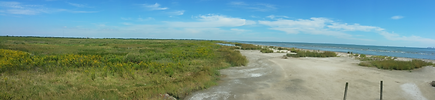
Little is known about Ischnodemus falicus, both for the genus and the species. However, it is a main herbivore in an important salt marsh Louisiana ecosystem – Spartiana alterniflora patches. This cordgrass is often used with marshland preservation methods, and yet little is known about the herbivores residing there. Understanding how this organism moves in a population setting will add to the understanding of the environment dynamics of a salt marsh system in Louisiana.


Five hypothetical forms of the density-emigration relationship, including density-independent emigration (DIE), positive density-dependent emigration (+DDE), negative density-dependent emigration (-DDE), u-shaped density-dependent emigration (uDDE), and hump-shaped density-dependent emigration (hDDE).
Forms of density-dependent emigration
Changing emigration patterns can have dynamic population consequences!
Individuals will emigrate from a patch for several reasons including to escape competition, avoid predators, find resources, or form a group. These emigrants in turn affect colonization and local densities of patches around the landscape, which can lead to changes in population persistence. The proportion of the population emigrating based on density (density-dependent emigration; DDE), has been widely accepted to be density-independent or positive density-dependent (DIE and +DDE respectively; see figure). However, other forms of DDE (see figure) are biologically possible.
But, do these other forms of DDE even exist in nature? To answer this, I reviewed 145 empirical studies of DDE to examine the range and frequency of each DDE relationship. As expected, the majority of these studies represented DIE and +DDE results; however, I regularly found the other forms of DDE (negative, u-shaped, and hump-shaped; see figure).
The DDE form a population has changes the stability of that population, particularly in small patches commonly found in fragmented landscapes. Using models incorporating patch size and landscape quality, my collaborators, Jerome Goddard and Ratnasingsam Shivaji, show that population persistence changes with the form of DDE. Negative and u-shape DDE forms allow for populations to survive in smaller patches, but at the risk of sudden extinction. Additionally, negative and hump-shaped DDE forms allow for different sized populations to persist in same-sized patches.
This review should be considered in future research. For example, to limit bias against detecting non-linear DDE forms in nature, future research should utilize methods that include wider ranges of density treatments and statistics that test for all forms of DDE. With further investigation of these forms of DDE, better predictions for species conservation (such as metapopulation extinction and invasive species movement) are possible as the form of emigration can change if a population will persist.

Plant communities in a fragmented landscape
In the Midwest region of the United States, forested areas have been removed to make way for agriculture and development. In the southern Midwestern states, including Indiana, cultivated and pasture agriculture lands account for 80-90% of rural landscapes. The remaining forests have been fragmented into small, often privately owned, woodlots. Due to their size, these forests typically have a high edge to interior ratio, which creates a greater influence of the surrounding agricultural land matrix upon the forest itself. Fragmentation influences the species in these forests through the distance between, size, age since disturbance, and shape of the forest in addition to management. By quantifying the intensity of these factors on plant species, management strategies could be modified to improve the ecological function of the fragments.


Harman et al. 2019
Harman Thesis
For my thesis, I applied island biogeography theory to a fragmented forest system in NE Indiana. Understory and midstory plant community metrics were compared to landscape features. Forest fragment area positively influenced understory and midstory richness. Distance to nearest fragment neighbor had a negative effect with midstory species space and neighbor count within 1 km radius. A negative relationship with perimeter: area ratio was noted in the understory species space and midstory diversity. Intermediate disturbance altered forest age, overstory diversity, and canopy cover, each of which had direct influence on under and midstory richness and diversity. Large forest fragments that are selectively harvested with some perimeter effect show the greatest amount of plant diversity. These results are comparable to other research done on forest fragments and island biogeography with regard to size and disturbance, but not distance, thus fragmentation principles are applicable to forest patches surrounded by an agriculture matrix in northeast Indiana.